
Energy Management - Statistics
Generators 911
Wind Power News >>

For more solutions please try www.hazeng.com or www.engineeringtrader.com

Here’s what happens, or should, when a generator must visit a service center.
Kevin Alewine/Renewable Energy Services. Shermco Industries, Irving, Texas./shermco.com

A technician tests a generator stator core. The condition of the steel effects efficiency and reliability.
Eventually, everything fails. Good predictive and preventative maintenance practices help prolong reliability and plan for the inevitable. But, sooner or later, something breaks that is beyond up-tower repair capabilities, and the generator will have to come down. How should a qualified repair facility be selected, and what happens to the generator during reconditioning or remanufacturing? A wind-turbine generator is a unique machine that requires a higher level of attention than a conventional industrial motor or generator. How can an owner be confident that the appropriate repair process is performed and documented accurately?
When qualifying a generator service company, many factors beyond the facility itself should be considered including experience, financial stability, quality programs, and technical support. While there are many electric motor shops, only a few specialize in wind-turbine generators and understand the requirements for that application. Long term reliable performance, while certainly important in industrial applications, becomes paramount when the machine is 300 feet in the air. A well remanufactured generator should, at a minimum, meet the performance and reliability specifications of the OEM machine. And when properly executed, the refab can often outperform and out last the original. Close attention to coil design and insulation properties, mechanical tolerances, and careful assembly can minimize the risk of another failure during the functional life of the turbine.
Preparing for removal
When disconnecting the generator in preparation for coming down-tower, any-thing unusual regarding the specific circumstances should be noted, including any alignment or vibration issues, obvious maintenance shortcomings, evidence of overload or electrical imbalance, or other
damage caused by outside forces such as turbine over-speed. All attached components should be included in the shipment to the repair facility including auto greasers, cable glands, brush assemblies, and any shaft mounted electronic equipment. All these components will be useful in assuring the repaired machine is properly returned to service. They also may provide clues to what caused the premature failure. This key evidence can be identified, studied, and considered for corrective actions. Actually, any and all information regarding performance before and after failure, including maintenance records and field test reports, could prove useful in developing the root-cause failure analysis.

What happens (or should) at the repair facility
When the generator arrives at the service facility, it should be tagged for identification and all pertinent data (model, serial, customer, site, and so on) collected and entered into a management system, whether electronic or paper-based. This is when the quality management system should be triggered to assure that all actions are properly recorded for the final reports. When approved by the customer, the generator should be inspected with great attention to detail. Digital photography has proven effective recording the initial condition as well as all major steps throughout the process. This allows clearly answering most questions and eases documentation.
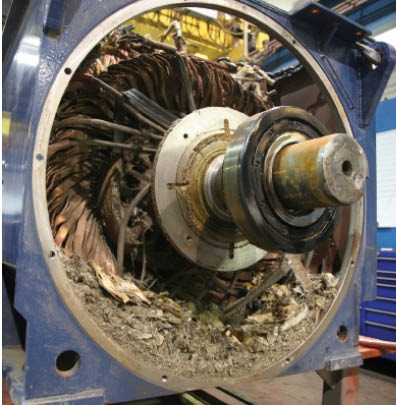
Centrifugal forces generated during an over-speed event destroyed the rotor and stator windings.
The generator should be disassembled carefully, noting all details, especially deviations from normal conditions. The goal is to repair what failed and provide as much insight as possible into the actual cause of failure. All major components should be cleaned and inspected and the stator and rotor, if applicable, should be steam cleaned and baked dry in preparation for electrical testing. The cooling unit, if included, should also be inspected for damage or other obvious signs of wear. When dry, the winding insulation resistance should be measured following the recommendations of IEEE 43. This should show whether there is actual damage to the windings that would complicate further testing or safety procedures. A more complete series of electrical tests, including surge testing and high potential testing of the windings, can then be performed to help confirm and identify a winding failure, if present.
A core-loss test of the rotor, or stator laminations, or both is called for when there is a winding failure, or mechanical damage to the laminations, even if the windings are in good shape. The average core losses and hotspot locations should be recorded. Loose wedges or blocking materials should also be noted. If there is a winding failure, the location and failure mode should be carefully photographed and recorded. Induction rotors are checked for bar integrity.
All mechanical fits should be measured and any obvious damage or other mechanical issues must be identified at this time. Also, a TIR (total indicated run-out) is strongly suggested. This series of measurements confirm the trueness of the shaft and rotor core. These mechanical checks help avoid unexpected complications to the repair process. The checks also help avoid unexpected and unpleasant cost increases.
At this point, the process should halt and the information reviewed by shop management, who will design a clear scope of work to complete the repairs. Materials, parts, and man hours should be estimated for customer and internal review. Normally, the generator will either be reconditioned or remanufactured. When the damage is so severe that scraping the unit is the only economical option, it should be permanently removed from service and its materials recycled in accordance with environmental regulations. Following established and proven processes controlled by clear ISO 9001 QMS documents and instructions helps assure that proper decisions are made during the inspection procedure.
The path to reconditioning.
Reconditioning requires cleaning of all components, repairing or replacing missing or damaged support materials and wedges, recoating the windings with protective resin, and reassembly and testing the generator. Repairs are first made to the rotor, or stator, or both where loose or missing wedges, damaged leads, or other damaged or weakened areas identified during inspection. Machining the shaft, or bearing housings, or both are completed to the manufacturer’s or customer’s specifications. The windings are coated with an appropriate resin to protect against...(Read whole article/video)
For more solutions please try www.hazeng.com or www.engineeringtrader.com

Explore EMS
More Editorial
Directory
This website is owned and operated by: MSL Media Limited

Co. Number: 05359182
© 2005 MSL Media Ltd. All rights reserved. E&OE