
Energy Management - Statistics
Laser-based wind sensor lets turbines grab more power
Wind Power News >>


A sensor that can see the wind ahead of a turbine would let it react to changes in wind direction and speed, thereby generate more power.
For decades, large utility scale wind turbines have been forced to rely on mechanical wind sensing devices that are mounted on the nacelles of the turbines to measure the wind speed and direction. These signals are fed into the wind turbine control system to adjust the turbine nacelle to account for the variations in the wind flow. The trouble with these devices is that they are located in the wrong position, in extremely turbulent airflows that must be time averaged to smooth out the fluctuations caused by blade interference and turbulence from the aerodynamic flow over the nacelle. The wind measured behind the wind turbine rotor blades bears no resemblance to the actual airflow that the turbine rotor system encounters flowing into the blades. The resulting misalignment in yaw and pitch, caused by the reactive nature of current wind sensors, has a tremendous affect on the efficiency of the wind turbine and the stress load damage imparted to the dynamic components.
Start with yaw
An important factor affecting wind-turbine efficiency is yaw alignment, a measure of a turbine rotor’s misalignment with the wind. To operate most efficiently, wind turbines should keep the turbine nacelle aligned with the wind. Because the wind speed and direction are always changing, the yaw misalignment is always present even when the winds appear to be “steady” as reported by the conventional mechanical or sonic anemometry in use. Although the alignment error between the wind direction and the
turbine nacelle cannot be completely eliminated, its magnitude can be greatly reduced, producing more energy and reducing turbine stress loads. If a turbine’s control system can assess accurate wind direction and speed far enough in advance of the turbine, it can better align itself with approaching wind.


For more solutions please try www.hazeng.com or www.engineeringtrader.com

Staying aligned with the wind significantly increases power output and reduces turbine stress. It also has the potential to guide the adjustment of blade pitch in anticipation of sudden stress events caused by gusts.
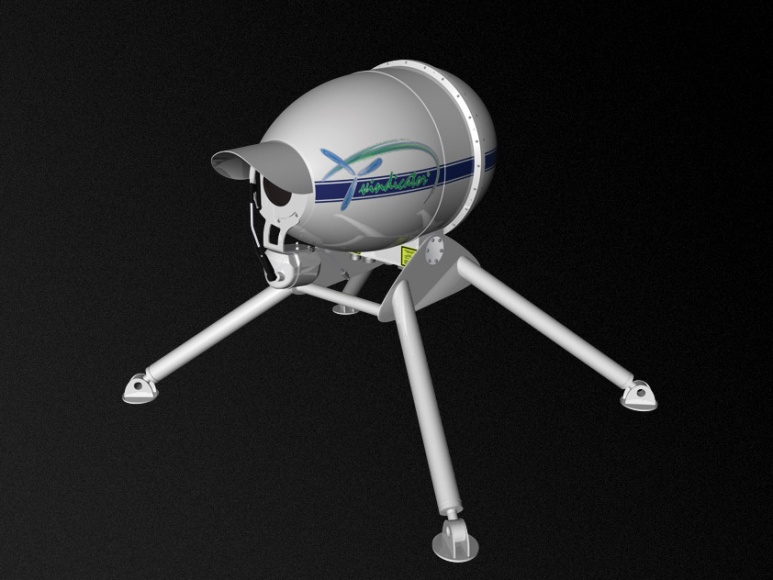
Catch the Wind, Inc. (CTW) has developed a laser wind sensor that, when mounted on the turbine nacelle, accurately measures real-time horizontal and vertical wind speed and direction. The Vindicator laser wind sensor (LWS) can look out to 300 meters ahead of the turbine to measure wind speed and direction as it approaches the turbine blades and transmits that data to the controls in sufficient time (20 seconds of lead time for a 35 mph wind) to reorient the turbine. The system is comprised of a base laser unit and a remote lens unit. The base unit is housed in a separate assembly that can be mounted inside the turbine’s nacelle and connected to the remote lens assembly. The technology uses Laser Doppler Velocimetry, an optical remote sensing technique similar to Doppler radar, to measure the minute frequency changes of light reflected by microscopic air particles moving with the wind to precisely determine wind speed and direction.
Challenges for mechanical sensors

The Nordex turbine shows the relative location of the remote laser unit on the nacelle.
Today’s turbines operate reactively because the sensors are mounted on the back of the nacelle – behind the turbine rotor blades. That means after a wind change passes a turbine, its mechanical, or ultra-sonic sensors, must detect the change, average out the variations in the disturbed windflow and then provide control signals to adjust the turbine’s direction. The resultant averaging and time delay, often several minutes long, means that the wind turbine is not operating as effectively in capturing all the energy from the wind, particularly in Region 2 (between the turbines cut-in wind speed and rated power wind speed) where most wind turbines spend the bulk of their operating time. This near-constant misalignment also generates unnecessary stress on blades, causing premature wear and damage to them and key turbine components. Repair or replacement of these major components represents a significant cost to the wind farm operations, and when coupled to the out of service time for repair, directly impacts the profitability and cost of wind energy. A feed-forward, laser-based wind sensor addresses these issues by taking a proactive approach to wind turbine control by assessing the wind before it reaches the turbine.
Small changes, big payoff
Misaligned turbines result in lost revenue, either by power output losses due to inefficiency, or by increased maintenance costs due to stress damage. Because the power output is theoretically reduced by the cosine cubed of yaw angle, the apparent power losses start to add up rapidly when the turbine is misaligned by more than 10 degrees. Trial data from Catch the Wind’s testing in on an operating wind turbine in Nebraska demonstrates that the nacelle misalignment may be significantly greater than conventional industry understanding.

The Nebraska Public Power District (NPPD) tested a Vindicator LWS last year on a Vestas V-82 wind turbine. The remote laser unit was mounted atop the nacelle and directed forward through the blades. The base laser unit was mounted inside the nacelle. A conservative control algorithm was implemented resulting in the Vindicator sensor controlling the turbine approximately half the time. During the month long test, the turbine’s power production showed an average increase of over 10% when the LWS was in control of the turbine yaw system. Additionally, a SWANTech Stress Wave Energy...(Read whole article/video)
For more solutions please try www.hazeng.com or www.engineeringtrader.com

Explore EMS
More Editorial
Directory
This website is owned and operated by: MSL Media Limited

Co. Number: 05359182
© 2005 MSL Media Ltd. All rights reserved. E&OE