Fluke delivers unmatched Safety to Solar professionals with tools specifically designed for high-voltage solar environments

FLUKE_October.jpeg

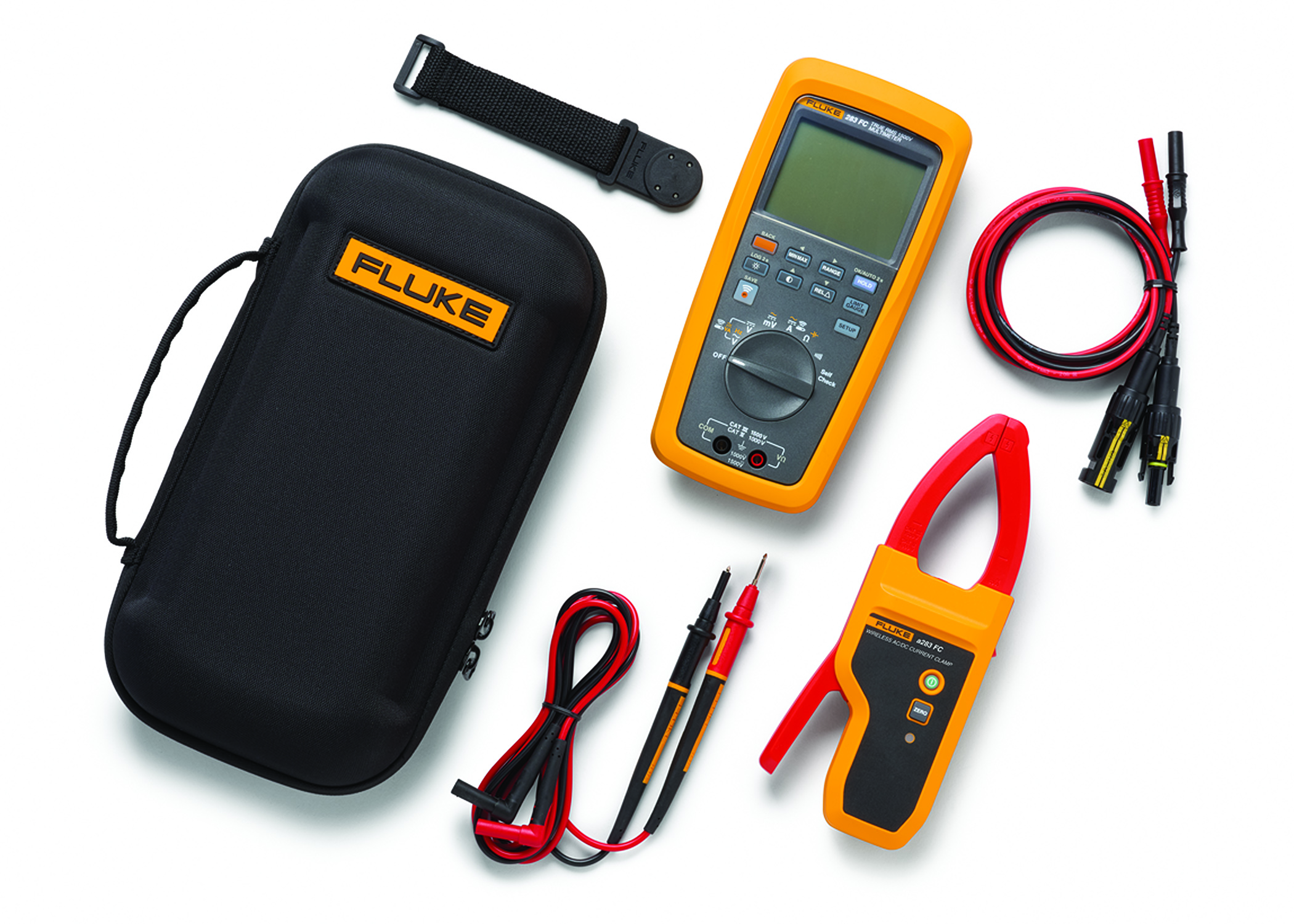
The new Fluke 283 FC True-RMS CAT III 1500 V Digital Multimeter and a283 FC Wireless Current Clamp provide the safety and accuracy to work in high-voltage solar environments with capabilities that streamline technician workflows  

Fluke, a global technology leader in the manufacture of compact, professional electronic test and measurement tools and software, announces the introduction of the  Fluke 283 FC Solar Digital Multimeter and the Fluke a283 FC True-RMS Wireless Clamp  which enable Solar professionals to work more confidently, without compromising safety in high voltage environments such as a testing individual panels, strings or invertors in a utility-scale solar photovoltaic (PV) array.

The new 283 FC Digital Multimeter from Fluke is designed to enhance safety and increase productivity, while also providing technicians with accurate, reliable, and repeatable results.

The Fluke 823 FC/PV Solar Kit includes CAT III 1500 V DC safety rated accessories that enable technicians to work confidently in high-voltage environments.  With Staubli MC4 test leads, professionals can quickly make reliable, secure connections to modules or strings to test DC voltage up to 1500 V DC, well suited to utility operations.

The TL175-HV CAT III 1500 V / CAT IV 1000 V rated silicone test leads offer flexibility for testing voltage, millivoltage, resistance, continuity, and capacitance on inverters, combiner boxes, PV arrays, and individual PV modules.

"Our digital multimeters are renowned for their exceptional accuracy, durability, and safety features making them the preferred choice of professionals across various industries for reliable and precise measurement,” said Jason Waxman, President of Fluke Corporation. “The Fluke 283 FC is uniquely positioned to cater to this market with both CAT III 1500 and CAT IV 1000 ratings prioritizing features that increase efficiency safety and reliability. It’s a powerful all-in-one tool for solar professionals."

Fluke 283 FC/PV Key Features and Benefits:

  • Highly Accurate Measurements: Provides precise voltage measurements for accurate frontline troubleshooting.
  • 60 A AC/DC Current Measurements: Safely troubleshoot individual strings of modules with the a283 FC wireless current clamp.
  • Visual and Audio Polarity Indicators: Help prevent accidental module wiring issues.
  • User-Defined Limit Gauge: Quickly make go/no-go troubleshooting decisions.
  • Unique Multimeter Readiness Self-Check: Ensures your meter is ready to test, providing confidence.
  • Large bright backlit display and illuminated keypad: ideal for working in dark environments.

The a283 FC True-RMS wireless current clamp simplifies the troubleshooting process without compromising safety and reliability. It measures both AC and DC current up to 60 A, ensuring precise readings for solar installations, electrical systems, and industrial equipment. Its thin jaw is designed specifically for cramped spaces like combiner boxes or inverters. Prioritizing safety at every step, the non-contact design allows for safe connections without touching live wires, plus wireless connectivity eliminates the hassle of tangled wires, allowing for measurements from a safe distance.

With the Fluke 283 FC digital multimeter and a283 FC wireless current clamp, technicians can measure voltage and current simultaneously and automatically calculate VA power. This feature eliminates the need to change the measurement setup, providing seamless and efficient data collection in the field.

Utilizing Fluke Connect™ with the Fluke Cloud Storage capability provides 283 FC users with an enhanced troubleshooting experience by allowing the 283 FC to transmit measurements to a smartphone or tablet for detailed analysis that is uploaded to the cloud.

For more information on the Fluke 283 FC True-RMS Solar Digital Multimeter and a283 FC Wireless Current Clamp, please visit Fluke 283 FC.

Revolutionizing oil analysis: Traditional vs Cutting edge technology

By Sanya Mathura (Strategic Reliability Solutions Ltd) & Neil Conway (Spectrolytic)

In our last article we focused on the question of whether oil analysis was still relevant today? While this is an age-old process, the benefits of oil analysis still continue to live on today although the methods involved have significantly evolved since its inception. In this article, we will do a deeper dive into the traditional methods of oil analysis versus some of the new cutting-edge technologies which exist today and whether we may see a replacement of one method over the other or a union moving forward.

If you’ve ever performed an oil analysis you know that this process follows certain standards which are listed in the report.  These standards govern the world of oil analysis and form the basis of how these tests are executed. There are committees dedicated to revising these standards to ensure that they are still relevant to the applications of today, one such committee falls under the ASTM body (American Society for testing and Materials).

Equipment has changed over time where oil sumps have become smaller but now produce more power. Oils are under more stress as they are expected to perform at higher temperatures under elevated environmental conditions and still protect the equipment. Global oil manufacturers work together with OEMs (Original Equipment Manufacturers) to ensure that the oils developed can work with their components in these increasingly harsher conditions. But what constitutes an oil “working properly”?

This is where oil analysis / sample testing plays a crucial role. Oil analysis tests have been standardized through authorized committees to ensure that the same test can be performed in different parts of the globe using the same procedures. This ensures that there can be a fair comparison of the results of these tests across the globe. These tests should also be repeatable (or get the same results every time they are performed). 

Typically, these tests are usually carried out in a laboratory environment, using state of the art equipment to achieve / maintain the required standards. However, sample taking, sample shipping and other human factors often result in misleading and / or extremely delayed reporting of the results. This is where emergent technology can alleviate some of these challenges.

Emerging technology – FluidInspectIR®

Spectrolytic’s FluidInspectIR-Inline is a comprehensive fluid monitoring system that uses an array of sensors (MIR, OPC, wear, viscometer, conductivity) to provide real time data on oil and fluid degradation parameters. At the heart of the system is a novel mid-infrared (MIR) sensor that measures the chemical composition of the fluid with parameters such as; TAN, TBN, ipH, oxidation, sulphation, nitration, water, glycol, soot, fuel dilution and additives. These can be measured, as a first in the field, with the same accuracy and in the same units as conventional labs.

There are a couple of areas where the FluidInspectIR can offer advantages as compared to traditional oil analysis. Here are a few of them:

Real Time Monitoring and Faster Results – with these online monitoring devices, users can readily get data throughout the day without waiting for the sample to be taken, shipped to a laboratory and then tested there. This significantly reduces the time between making decisions which could negatively impact the equipment’s performance. Within our industry, this time is absolutely critical as the cost of unplanned downtime for the affected assets can be millions of dollars.

Cost-Effectiveness – every time a sample is taken, there is a cost involved. The sample taking process is usually quite lengthy as often permissions have to be obtained since more organisations are trying to reduce potential health & safety risks by minimizing human-machine interactions.
Once a sample has been obtained it needs to be shipped to a laboratory. This not only has costs attached to it, but many couriers are now making it very difficult to ship oil samples. In addition, each shipment of a sample carries also an implied CO2 footprint.
fig1_Oct.jpeg

Figure 1: Comparison of different routes of oil sampling

As shown in figure 1 the resulting cost savings from utilizing real time inline sensors compared to other methods can be summarized as follows:

  • Human assets can be utilized more effectively without allocating time for them to take oil samples
  • Trend analysis based on real time; laboratory equivalent data allows the end customer to move from a time-based maintenance process to a data driven maintenance process
  • Early failures can be spotted very easily and unplanned down time, the nightmare of every asset manager, can be minimized
  • Oil drain intervals can be extended in a safe and controlled manner which can result in significant operational efficiency gains and reduced CO2 footprint

Accuracy and Reliability – getting an accurate representative sample using conventional oil sampling methods can be challenging at times. If the sample is taken at the wrong point (right after the filter or at a dead leg), it might not be representative of what is happening on the inside of the equipment. As such, it can completely derail the trend being established for that component and allow the users to believe that something is terribly wrong with that component.

With the FluidinspectIR online monitoring system, the sample delivery to the sensor is automated and standardized ensuring that the sample is delivered to the sensor in the correct way every time. Therefore, the users can rest assured of getting the sample taken at the right location (ensuring a proper representation of the system), at the same location (ensuring an accurate trend of the data) and with the same technique (which completely avoids any variation from human operators).

 As the FluidInspectIR uses mid-infrared spectroscopy which is identical to the technique used by laboratories (FTIR), the data provided by the FluidInspectIR system has, at least, the same accuracy as those produced by a laboratory as shown in figure 2 below.
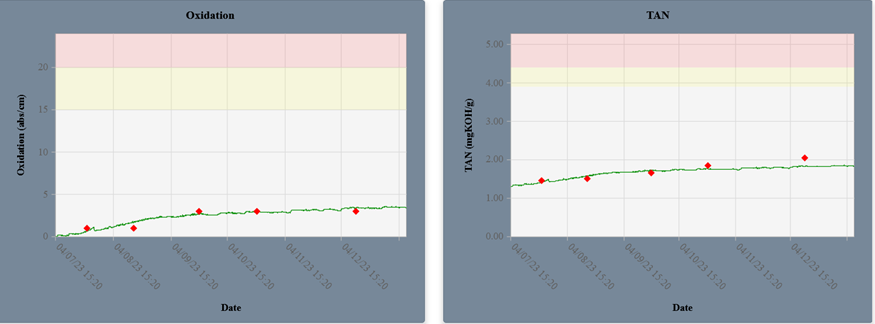
fig_2_Oct.jpeg

Figure 2: Comparison of the FluidInspectIR technology to periodic oil checks using a laboratory (red circles)

Actionable data and improved maintenance – with real time data, failures can be prevented and major unplanned downtime eliminated. With the online monitoring system, it is easier to trend an increase in wear metals, change in viscosity, water ingress or any other parameter changes which would warrant some form of maintenance intervention. This provides users with the information they need at the right time without any further delays due to shipping of samples or an inaccurate sample being sent off as shown in the case study in figure 3 where a diesel engine on a dredging vessel saw spiked concentrations of water that coincided with the vessel being moored in harbour. With the quick action of the inline sensors, they were able to save £115k over 9 months.
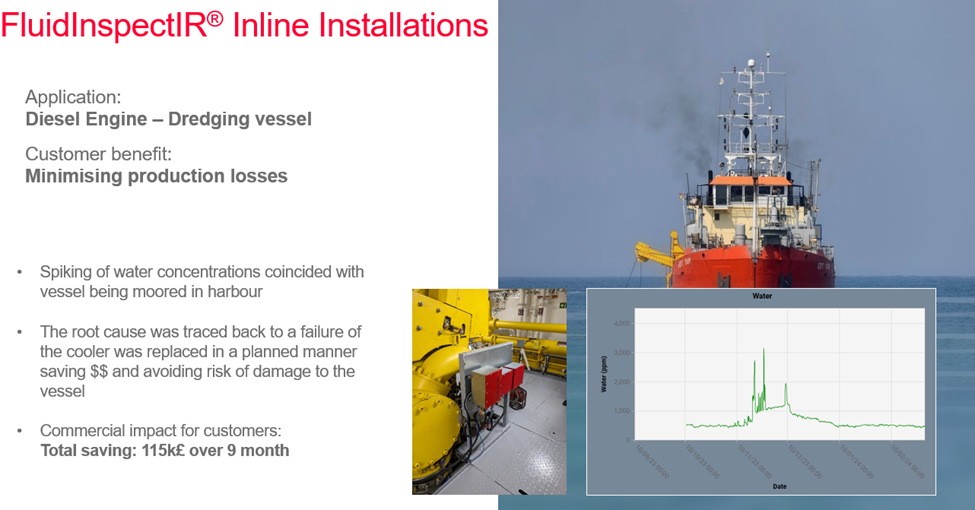
fig_3_Oct.jpeg

Figure 3: Case Study for Diesel engine customer  

Data Integration and Remote Monitoring – traditionally, oil analysis results lived in databases which could be accessed electronically, or they were emailed and stored in a filing system. But these results are only available after a sample has been taken and sent off to the lab. This is how FluidInspectIR takes it a step further where assets can also be monitored remotely, in real time.

Imagine being able to monitor the conditions of a particular component while being offsite or multiple components for various sites. This can be particularly useful when trying to troubleshoot an issue related to a system process, especially across sites. This is one area that traditional oil analysis would not be able to mimic as the sample may not be taken at the exact same time as the ongoing system process therefore not allowing a correlation. 

Of particular importance is the ability to trend data across multiple assets. This can be critical if there is a significant environmental factor influencing the condition of the oil which may affect many of the components in the fleet. Being able to easily and quickly detect this can be the difference between a productive day and one that has gone into unplanned downtime.

The above offers some advantages of using these inline sensors but what really sets the FluidInspectIR apart?

Historical inline sensors have employed dielectric or impedance-based sensing. Impedance based sensing is slightly more advanced than dielectric sensing but still only measures a few electrical parameters such as oil resistance, capacitance and inductance which assist in detecting the polar molecules in the oil.

However, complex algorithms are usually used to convert the electrical data into a meaningful value such as TBN or develop a trend based on a dimensionless value. Laboratories use MIR Spectroscopy which is the same technology utilized by FluidInspectIR. As such, the data / results are given in the same units and accuracy as labs.  

The FluidInspectIR technology analyses the spectra in the wavelength ranges which have a chemical meaning for the application in which the sensor is being used, such as turbine oils, EALs, gear oils, engine oils etc. This specificity in the MIR spectrum, coupled with several mechanical and electrical design features allow lab accuracy in the field.

Fig_4_Oct.jpeg

Figure 4: Market validation and asset examples

The Hybrid approach

While the FluidInspectIR Inline sensors can provide actionable data required for preventive maintenance strategies, there are some parameters where a lab analysis would certainly be advisable. These are more specialized tests such as Air separation / Demulsibility or FZG loading tests which require some fairly complexed processes in which the oil has to stand for some time during the procedure or different loads have to be added until a particular characteristic is met.

With that being said, inline OCM technology has made significant advancements and the FluidInspectIR is currently considered state of the art providing lab equivalent data in real time. In addition, it is also capable of measuring nonstandard properties, such as oxidation by-products which can relate to varnish by-products or the potential to form varnish as well as monitor the quantity of antioxidants. The monitoring of these parameters could not have been done a decade ago as the technology simply wasn’t available.

The future of oil analysis will certainly be a hybrid approach where inline sensors continuously monitor the fundamental parameters and when limits are reached (either below or above), or the trending analysis shows a peculiar behavior, then specialized additional testing can be pursued using the lab infrastructure and expertise.

In this way, resources are conserved when the oil appears to be within its limits and functioning as it should. However, when these limits are reached and the component could be in danger, specialized resources will be deployed to ensure that the component does not suffer a fatality. The way forward for oil analysis is definitely a hybrid approach mixing the traditional with some of the cutting-edge technologies.

Bio:

Neil Conway – Applications Manager, Spectrolytic

Neil is the Applications manager for Spectrolytic where he develops and manages new and current measurement applications for all the product lines. Neil is also extensively involved in sensor characterisation, product development, customer training, and technical marketing.

Previously Neil has held Process Engineering positions in semiconductors with Motorola and Atmel and operated as Wafer Fabrication Manager with IR Sensor company Pyreos where he developed and commercialised the first thin film PZT IR sensor manufacturing line. 

Neil is a chartered Engineer (CEng) and Scientist (CSci) and corporate member of the Institution of Chemical Engineers (MIChemE) and holds a BEng (Hons) in Chemical & Process Engineering from Strathclyde University.

Bio:

Sanya Mathura, REng, MLE

Founder, Strategic Reliability Solutions Ltd

Sanya Mathura is a highly accomplished professional in the field of engineering and reliability, with a proven track record of success in providing solutions to complex problems in various industries. She is currently the Managing Director of Strategic Reliability Solutions Ltd, a leading consulting firm that specializes in helping clients improve their asset reliability and maintenance practices.

Sanya holds a Bachelor's degree in Electrical & Computer Engineering as well as a Masters in Engineering Asset Management from The University of the West Indies and has over 15 years of experience in the industry. She has worked with several well-known companies and has been recognized for her exceptional work in the field of reliability and lubrication engineering. Her expertise in developing and implementing asset management strategies, risk assessments, and root cause analysis has earned her a reputation as a subject matter expert.

As the head of Strategic Reliability Solutions Ltd, Sanya leads a team of highly skilled professionals who provide a wide range of services to clients across various industries, including oil and gas, manufacturing, and transportation. Under her leadership, the company has expanded its services and is now recognized as a leading provider of reliability engineering services in the industry across the globe.

In addition to her work at Strategic Reliability Solutions Ltd, Sanya is an active member of several professional organizations, including the International Council for Machinery Lubrication and writes technical papers for several organizations. She is also a sought-after speaker and has presented at various conferences and seminars on the topics of reliability engineering and lubrication. She is also an avid advocate for women in STEM.
MILWAUKEE® Introduces the Future of Precision Fastening for the Solar Industry

Developed and tested for the solar industry, M18 FUEL™* ONE-KEY™ TORQUE-SENSE™ ½” Controlled Mid-Torque Impact Wrench with Friction Ring and M18 FUEL™ ONE-KEY™ TORQUE-SENSE™ ½” Controlled Compact Impact Wrench with Friction Ring are the industry’s most repeatable impact wrenches.

TORQUE-SENSE™ torque control overcomes common variances seen on the job site, maintaining target torque better than competitive products that use blow counting algorithms. This performance is enabled by new to world sensors designed in house by MILWAUKEE®, that feed sophisticated machine learning algorithms. Every trigger pull is recorded, and data can be downloaded via the ONE-KEY™** application for customisable reporting to ensure confident installation. This product is ideal for utility-scale solar projects were eliminating the 2-step method on the jobsite can deliver up to 3X faster installation speed. MILWAUKEE® offers best-in-class performance and application speed with M18 FUEL™ technology, enabled by POWERSTATE™ brushless motors, REDLINK PLUS™ tool intelligence, and REDLITHIUM™ battery technology. Operating torque range for the Compact version is 68 – 203 Nm and 68 – 338 Nm for the Mid-Torque option.

Served by large construction companies that purchase large quantities of tools and support equipment, this segment’s growth requires complementary expansion in EPC (Engineering, Procurement and Construction) capacity. For industries serving these EPCs, important opportunities are consequently created, requiring significant growth in solar farm construction to meet this growing demand and innovative equipment to support this acceleration.

MILWAUKEE® is committed to improving productivity by providing performance-driven and trade-focused solutions so users can perform an entire day's work on one battery system. The M18 FUEL™* ONE-KEY™ TORQUE-SENSE™ ½” Controlled Mid-Torque Impact Wrench with Friction Ring and M18 FUEL™ ONE-KEY™ TORQUE-SENSE™ ½” Controlled Compact Impact Wrench with Friction Ring are fully compatible with the entire M18™ line, now offering more than 290 solutions.

*M18 FUEL™ is engineered for the most demanding tradespeople in the world. Delivering unrivalled performance, all M18 FUEL™ products feature three MILWAUKEE®-exclusive innovations—The POWERSTATE™ Brushless Motor, REDLITHIUM™ Battery Pack and REDLINK PLUS™ Intelligence Hardware and Software—that deliver unmatched power, run-time, and durability on the jobsite. Simply put, M18 FUEL™ tools are the most powerful 18V cordless tools in their class.

 **ONE-KEY™ is the first digital platform for tools and equipment. By integrating industry-leading tool electronics with a custom-built cloud-based program, ONE-KEY™ provides a new level of control and access to information that revolutionises the way work gets done. The ability to customise, track and manage through ONE-KEY™ fundamentally changes the way users interact with their tools.

Specifications

M18 FUEL™ ONE-KEY™ TORQUE-SENSE™ ½” Controlled Mid-Torque Impact Wrench with Friction Ring

M18 ONEFMTIW2FC12-0X

  • Battery Type: Lithium-ion
  • Battery System: M18 FUEL™
  • Impact Rate: 0 – 1800 / 0 – 2300 / 0 – 2800 / 0 – 3400 ipm
  • Max Bolt Diameter: M22
  • Max Torque: 338 Nm
  • No Load Speed: 0 – 1250 / 0 – 1725 / 0 – 2000 / 0 – 2400 rpm
  • Nut Busting Torque: 746 Nm
  • Tool Reception: ½” Square
  • Weight with Battery Pack (EPTA): 2.5 kg (M18 B5)

Kit Includes: (1) M18 FUEL™ ONE-KEY™ TORQUE-SENSE™ ½” Controlled Compact Impact Wrench with Friction Ring

 M18 FUEL™ ONE-KEY™ TORQUE-SENSE™ ½” Controlled Compact Impact Wrench with Friction Ring

M18 ONEFIW2FC12-0X

  • Battery Type: Lithium-ion
  • Battery System: MX FUEL™
  • Impact Rate: 0 – 1650 / 0 – 2475 / 0 – 3000 / 0 – 3500 ipm
  • Max Bolt Diameter: M22
  • Max Torque: 203 Nm
  • No Load Speed: 0 – 1125 / 0 – 1525 / 0 – 1850 / 0 – 2325 rpm
  • Nut Busting Torque: 298 Nm
  • Tool Reception: ½” Square
  • Weight with Battery Pack (EPTA): 2.0 kg (M18 B5)

Kit Includes: (1) M18 FUEL™ ONE-KEY™ TORQUE-SENSE™ ½” Controlled Mid-Torque Impact Wrench with Friction Ring

Perfect Match

M18 ONEFMTIW2FC12 & M18 ONEFIW2FC12

SHOCKWAVE™ IMPACT DUTY impact sockets – ½” PACKOUT Impact socket set - 16 pc (4932480943)

To find out more about M18 FUEL™ ONE-KEY™ TORQUE-SENSE™ ½” Controlled Mid-Torque Impact Wrench with Friction Ring and M18 FUEL™ ONE-KEY™ TORQUE-SENSE™ ½” Controlled Compact Impact Wrench with Friction Ring, see video footage of it in action or find your nearest store, please visit https://uk.milwaukeetool.eu/.

Visit Milwaukee Tool UK's Instagram and LinkedIn for further information.


Restoring Efficiency in Petrochemical Heaters through Robotic Cleaning

SNIP_OCT.jpeg

A leading Saudi petrochemical producer in Jubail, renowned for its commitment to innovation and sustainability, faced a challenge with three of its platforming charge heaters in the Oleflex (polypropylene) unit. An evaluation revealed that the primary issue was convection section fouling caused by the accumulation of refractory fibers and other debris.

Recognizing the need for a reliable and efficient solution, the company sought an approach that would not only address the immediate problem but also contribute to the overall reliability and optimization of its operations while aligning with its focus on innovation and sustainability.

The Solution: IGS Robotic Convection Section Cleaning

The petrochemical company partnered with IGS Tube Tech, a specialized robotic and field-applied industrial solutions provider. Tube Tech proposed deploying its robotic convection section cleaning ROV (remotely operated vehicle) to remove the accumulated fouling and restore the heaters' efficiency.

The robotic cleaning solution offered several key advantages:

  1. Effective Fouling Removal

The ROV, equipped with a high-powered cleaning lance and advanced maneuverability, could effectively dislodge and remove the refractory fibers and debris from the convection sections.

  1. Improved Safety

By utilizing a remotely operated robotic system, the cleaning process eliminated the need for personnel to enter the potentially hazardous heater convection sections, enhancing overall safety.

  1. Sustainable Approach

Aligning with the company's sustainability commitment, the robotic cleaning process generated minimal waste; the flow rate of the jetting arm is only 24-l/ min, and the flush bar is 67-l/min.

Implementation and Results

The IGS Tube Tech team carefully deployed the robotic convection section cleaning ROV, navigating through the three affected heaters. The robotic system effectively dislodged and removed the accumulated fouling, restoring the heaters' convection sections to their design specifications.

The targeted and thorough cleaning process effectively removed 90-95% of the accumulated deposits, restoring the heaters to their design parameters, and improving overall plant performance and productivity. Furthermore, the sustainable and safe nature of the robotic cleaning solution aligned with the company's commitment to innovation and environmental responsibility.

Conclusion

The successful implementation of the IGS robotic convection section cleaning solution at the petrochemical company's facility demonstrated the power of innovative and sustainable approaches to addressing complex industrial challenges. By leveraging advanced robotic technology, the company efficiently restored the efficiency of its platforming charge heaters while aligning with its strategic objectives of continuous improvement and environmental stewardship.

In October 2024 Integrated Global Services (IGS) was announced as a winner in the 2024 Gulf Energy Information Excellence Awards in the Best Controls, Instrumentation, Automation Technology – Downstream category for its patented Convection Section Cleaning Rover.

Integrated Global Services, IGS - Your Efficiency & Reliability Partner

Revolting for A Reason

revolting.jpeg

Andrew Jones, the Technical Director at Axair Fans explains the deeper why behind their latest innovative and disruptive campaign – We’re Revolting.

 You’ve hopefully seen our revolting advertising out in the wild – and if not, or simply as a reminder, it features a few candid shots of me and our team in compromising situations; picking noses, ears, smelling armpits, or showing their lunch still in-between their teeth. Revolting!

The visual is eye catching yes, but the messaging is powerful when you really get to grips with what we’re saying. If you’ve read my previous contributions on complacency in the fan industry, the importance of adding value to customer interactions, or the way we’re helping to bridge the skills gap in the industry, then you’ll understand that we’re leading a dramatic change from the front. A revolution if you will, and to lead a successful revolution, you need an initial revolt.

A revolution implies a successful revolt occurred which resulted in that major change, something we’re doing by making waves in changing the behavioural norms, advocating for a change in the way customer response times are reduced, how feedback on technical support is given within a set time, communication is paramount, and the same pre-sales support is delivered regardless of the value of the potential opportunity. Quite simply we’re waving the flag for what the customer deserves. We’re revolting!

We’ve not anchored our revolt on assumptions either, we’ve delivered and shared meaningful actions taken from research feedback, including customers not getting attention from the industry giants unless they’re a 6-figure customer, the average wait time on technical responses being 6 weeks or beyond, and the sheer amount of product fails with no final diagnosis or resolution. We realised that what we offer is unique, we’re focused on customer outcome. It deserves to be shouted about, because it’s the basics of what the customer experience should be about but quite simply isn’t in the industry. Complacency and fear are leading the way right now.

So, the next time you see a post with one of our team’s uncomfortable poses disrupting your social feeds, landing in your inbox or printed in an industry publication, give a thought to your current situation. Are you an advocate for change and how are you going about this? The way customers go about sharing their advocated behaviours is now more important than ever, word of mouth for example in the digital intense era we’re in, spreads incrementally through online channels, very different to 20 years ago. Increasingly people make their decisions based on the influence of peers and people like them, to decide who to put their trust into. LinkedIn is a prime channel with clear examples of grouped consensus, support and hyping each other up in this industry, specifically within the commercial kitchen sector. If you’re an advocate for changing fan supplier behaviour, then I encourage you to give yourself a nudge and examine the behaviours within your business. Maybe it’s reviewing your supplier list to see if they truly add value, looking at product variations outside of your comfort zone, or demanding greater collaborative efforts from your component suppliers.  As always, we’re here to support our customers outcomes and goals, that revolutionary change is right here in this text, as they say in Stoke, Viva la Revolution.

www.axair-fans.co.uk

Proactive Maintenance: The Key to Reducing Unscheduled Downtime

Unscheduled downtime can have a significant impact on manufacturing companies

FLIR_Oct.jpeg

When production halts unexpectedly, it disrupts the entire supply chain, leading to delays in product delivery and potential loss of customer trust. Financially, the costs can be substantial, including lost revenue, overtime pay for workers, and expenses for emergency repairs. Additionally, frequent downtime can damage equipment, reducing its potential lifespan and increasing maintenance costs.

Thermal imaging, also known as Thermography is a powerful tool for preventative maintenance in manufacturing. It involves using infrared cameras to detect heat patterns and anomalies in equipment. By identifying areas of excessive heat, which often indicate potential failures, thermography allows maintenance teams to address issues before they lead to costly unscheduled downtime. One of the key benefits of thermography is its non-invasive nature. Thermal imaging is performed while equipment is operating, minimizing disruptions to production.

This proactive approach helps in identifying problems such as electrical faults, mechanical wear, and insulation failures at an early stage. Consequently, it enhances the reliability and efficiency of machinery, extending its lifespan and reducing maintenance costs. Moreover, thermography provides valuable data that can be used to track the condition of equipment over time.

This data-driven approach enables more informed decision-making and better planning of maintenance activities. Overall, thermography is an essential component of a robust preventative maintenance strategy, ensuring operational continuity and safety.

flir_2.jpeg

Teledyne FLIR is a leading company specializing in the design and production of thermal imaging cameras and sensors. Renowned for their innovative technology, FLIR's products are used across various industries, including manufacturing, security, and environmental monitoring. FLIRs cameras are sophisticated instruments that can appear daunting to the untrained user, with specialist applications requiring a deep knowledge of thermography to provide valuable insights. On the other hand, FLIRs thermal imaging cameras can simply be viewed as tools to do a job, and that job is to inform 1/2 maintenance teams about the condition of critical assets.

The information can provide information to predict the maintenance required, prevent failure, and avoid unscheduled downtime. While training can be provided by organisations such as the Infrared Training Centre, or online via the FLIR Academy; FLIR offer multiple features to support both experienced and inexperienced thermographers to monitor their equipment. For example:- FLIR Exx-series, and Txxx-series of cameras can be set-up by an experienced user to follow an ‘inspection route’, then less experienced or even beginners can follow the same route, with the camera guiding its operator to take accurate and usable images, pre-selecting the settings and parameters as required.

At the end of the inspection, the thermal images can be sync’d wirelessly to a pre-prepared report, allowing easy analysis and interpretation. This might all sound complicated, but it is just a process that once set-up, supports inexperienced thermographers to capture data in a meaningful way. All designed to provide insights into the condition of equipment around a factory, production plant or manufacturing facility. If your maintenance teams are forever ‘fire fighting’, on high-alert, or waiting to react urgently to equipment failures, then it’s time to invest some more time and energy to get ahead of unplanned downtime, and monitor the condition of equipment. One of the best ways to do this is through thermal imaging which can be as affordable as companies need it to be, with training, or guided inspection tools readily available to meet the requirements of the technicians and engineers responsible for maintaining equipment uptime. www.FLIR.com has more information, especially in the ‘Condition Monitoring’ section where you can request a call from one of the team of experts, who will be happy to talk through the solutions and features, or organise an on-site demo to see how FLIR cameras can support your organisation.

EEMUA publishes new guidance on written schemes of examination

EMMUA_Oct.jpeg

The Engineering Equipment and Materials Users Association (EEMUA) has launched EEMUA Publication 248 (Edition 1), 'UK Pressure Equipment – A guide to the information to be supplied to the PSSR Competent Person for drawing-up a Written Scheme of Examination'.

EEMUA 248 has been written to aid stakeholders in the process of transfer of knowledge from those responsible for the manufacture of equipment, assemblies and systems to the user/owner and competent person who are responsible under the Pressure Systems Safety Regulations 2000 (PSSR) for a written scheme of examination (WSE).

To draw up an effective WSE and enable effective examinations, inspections, repairs and modifications to the equipment once it enters service, the transfer of such information and knowledge is imperative. In the UK, it is illegal to operate pressure systems which fall under the PSSR without establishing safe operating limits and having a suitable WSE in place.

The new guidance has been developed through a collaboration of engineers and representatives from EEMUA, the Pressure Equipment Consultation Forum (PECF) and the Safety Assessment Federation (SAFed) in consultation with other stakeholders within the pressure equipment industry. It incorporates technical advice from the Health and Safety Executive (HSE) in the UK.

EEMUA 248 Edition 1 is free to download from the EEMUA website.

The publication is issued jointly by EEMUA and SAFed (as PEDG03).

One device for instant process visibility in real time

Maximise real-time visibility on industrial processes with cutting edge RFID performance. The IRX200 from Brady combines powerful RFID reading with integrated edge computing and native OT & IT connectivity to support greater warehouse and production efficiency.

Instantly see the status and evolution for both work-in-progress in production, and stock levels in the warehouse, using the same hard- and software. Reduce production interruptions. Track inventories automatically with an RFID reader that can pick up 1000 items per second. Streamline processes and enhance output using accurate, real-time, automated and programmable data that enable fast, accurate decision making and effective continuous improvement.

brady_oct.jpeg

Unique, all-in-one tracking

Read battery-free RFID tags right out of the box with the IRX200’s all-inclusive functionality. An integrated, high gain RFID antenna makes the IRX200 easy to install and maintain. The RFID reader does not require external antennas. Native OT & IT connectivity, including Profinet IO and OPC UA, enable smooth, reliable data throughput. Before sharing, data can be processed by a built-in edge computer that nullifies latency and reduces facility cloud bandwidth consumption. Equipped with powerful computing capabilities, the IRX200 can run RFID reader and AI apps to process data in real-time, and share them with stakeholders and other machines in the most optimal way.

Enhanced visibility. Industrialised reliability.

The IRX200 is designed for industrial environments. With EN 60068-2-27 shock, EN 60068-2-6 vibration, and IP67 ingress protection tested mechanics, the reader can be mounted on almost any racking, conveyor, forklift and indoor vehicle. An operating temperature range of -20°C to 55°C makes the IRX200 useful in many industrial environments and applications.

brady oct 2


With the IRX200, a large number of industries can power productivity using insights and decisions supported by real-time, actionable data from their own industrial processes.

Learn more about IRX200 fixed reader on Brady websites.

A significant leap in workplace efficiency

Bring your workplace to the next level of efficiency and productivity with reliable RFID. Locate, identify, track and trace multiple assets at once from a 15m distance without ever having to lay eyes on them. Or cover your entire workplace with well placed fixed RFID readers to maximally accelarate asset tracking. Quickly guide employees to the assets they need in the most optimal order, fully automate inventories and check any outgoing cargo for completeness in seconds.

Get some inspiration from our free guidebook >>

Top technologies for conveyor maintenance ~ Preventing increased costs ~

foxmere.jpeg

The 2023 State of Conveying report compiled by Cablevey Conveyors, a global speciality conveyor manufacturer, states that 81 per cent of budgets dedicated to conveying equipment and maintenance are ‘significantly increasing’ this year. Here, Tom Cash, director of automation parts supplier, Foxmere, explains how the latest innovations in conveyor maintenance can help engineers to reduce the cost of planned and unplanned downtime. 

Conveyor systems are complex mechanical assemblies with numerous moving parts that require regular maintenance, with common problems including belt slippage, motor burnout and seized rollers.

In the food industry alone, it’s been reported that manufacturers lose a staggering £180 billion to downtime annually — that’s 490 million per day and the equivalent of 20 per cent of their working time. 

Therefore, all conveyor systems must have a robust maintenance strategy in place.

Cleaning challenges

Manual cleaning will always be necessary for some conveyors and applications — you just can’t escape it. 

In fact, the Food and Beverage Industry 2023 State of Conveying report revealed that the top conveyor challenge is cleaning and maintenance, which came in first by some margin at 53 per cent. 

Conveyors use belts, chains or rollers to transport items, each with unique advantages and maintenance needs. Manual roller conveyors use gravity to move objects, while powered rollers handle higher payloads and operate quietly. 

Maintaining roller conveyors involves keeping them clean and free from contaminants like glue and chemicals. Yet accumulated debris, particularly from environments like welding areas, can increase friction and cause rollers to jam. 

In addition, rollers are equipped with clutches that control torque direction, and these clutches should be checked and replaced when they reach their maximum adjustment point. 

Regular visual inspections of rollers are also recommended, with weekly checks for high-production environments and monthly or quarterly checks for lower production levels. Here, marks on rollers may indicate process issues rather than roller problems, such as issues with transfer pallets. 

Although conveyor companies are now focusing on making the cleaning process more efficient, some suppliers have streamlined maintenance by reducing the tools required for disassembly. 

For example, Dorner's tip-up tail belt tensioning system allows for quick preparation of the conveyor for cleaning in a minute, and the entire conveyor can be disassembled in three minutes without tools. The optional belt lifter facilitates easy access to clean the underside of the belt and the conveyor frame. 

The use of AI 

At BMW Group’s plant in Regensburg, an advanced predictive maintenance system has been implemented to monitor and manage conveyor technology used in vehicle assembly. 

This system uses AI to analyse data from existing conveyor components, allowing it to detect potential faults before they cause disruptions. 

The system can identify irregularities that might indicate impending issues by continuously examining parameters, such as power consumption and conveyor movement. 

Furthermore, the system operates without the need for additional sensors, relying instead on data from current conveyor controls and load carriers. 

This data is transmitted to BMW Group’s predictive maintenance cloud platform, which is processed by advanced algorithms that detect anomalies. When a potential issue is identified, the maintenance control centre receives a notification, enabling rapid response to take affected vehicles out of production.

The system is also continuously improved through these practical insights, with the goal of refining algorithms and integrating recommendations into maintenance protocols.

Currently, around 80 per cent of the main assembly lines at Regensburg are monitored by this system and it is believed to prevent approximately 500 minutes of downtime annually. This success has led to its use in other BMW plants. 

Time and money

Maintenance costs precious time and money, and as many of you will understand, unplanned maintenance costs even more.

Therefore, it’s no surprise that, in the aforementioned survey, 69 per cent of respondents clean their conveying systems three or more times per week, with 38 per cent dedicating even more time to this task.

It’s crucial to establish a well-planned maintenance schedule and employ advanced technologies, such as those mentioned, to ensure the longevity of conveyor systems and reduce the cost of downtime.

Automation suppliers play a key role in supporting these strategies by providing the necessary parts and expertise to implement an effective maintenance approach. 

With the right approach and resources, companies can reduce the likelihood of unplanned downtime as well as the duration of planned downtime — at a time when maintenance budgets are increasing.  


Contact Foxmere today for a no-obligation quote on automation components in conveying systems, including new, replacement or obsolete parts.

BEARINGS PLAY PIVOTAL ROLE IN TODAYS LANDING GEAR SYSTEMS

bearings.jpeg

Aircraft landing gear has critical engineering requirements due to the demanding and varied forces it must withstand during take-off, landing and ground operations. Regarded as a ‘mechanical marvel’ by some aviation experts, it is certainly a big deal with the world’s top airline manufacturers considering the fact that it accounts for around 20% of total aircraft maintenance and around 7% of the total weight of today’s commercial aircraft.

Aircraft Landing Gear – The Facts

When an aircraft lands, the landing gear has to absorb the entire weight of the aircraft, which can range from around 64,500kg for an Airbus A320 and up to around 201,800kg for a Boeing 777. Clearly the landing gear must be robust enough to handle not only the vertical load, but also the horizontal forces generated by the forward motion of the aircraft. Additionally, during landing, the gear must absorb the impact energy which can be substantial, especially during hard or emergency landings. Therefore, the key requirements demand designs and materials that can dissipate energy effectively, while avoiding structural failure.

Specialist Suppliers – Ensuring Maximum Efficiency and Safety

Today landing gear is typically manufactured by specialist suppliers to the aviation industry, who then supply to the major aircraft manufacturers. This is because the landing gear and shock absorption technologies are recognised as specialist, separate fields of science when compared to other aspects of aviation technology. Beyond impact absorption landing gear must also provide optimum stability and control on the ground as aircraft often encounter varying ground conditions, including uneven and slippery surfaces and crosswinds. The design must ensure that the aircraft maintains directional control during taxiing, take-off and landing, even under adverse weather conditions.

Meeting the Challenges

To achieve this today’s landing gear systems incorporate features such as shock absorbers, anti-skid braking systems and steering mechanisms.

These components must work together seamlessly to prevent the aircraft from veering off the runway or skidding, ensuring passenger safety whilst minimising wear on the aircraft’s tyres and other components. The landing gear must also be designed with considerations for weight and space constraints because fuel efficiency as part of overall aircraft performance, has never been more important than it is today. Therefore, the landing gear must be lightweight yet strong, utilising advanced materials such as titanium alloys, or high strength composites. Also the landing gear must be retractable to reduce aerodynamic drag during flight which means complex mechanical systems are needed to ensure reliable extension and retraction. Balancing these requirements; strength, stability and weight efficiency, while also integrating the landing gear into the aircraft’s overall design, makes it one of the most challenging aspects of aircraft engineering.

Precision Bearings and Tooling Equipment - Essential Components

Specialist bearings are an essential component of innovative landing gear systems particularly when applications involve landing gear struts and actuators and precision bearing and tooling specialists CARTER MANUFACTURING are approved aerospace bearing suppliers to industry leading landing gear manufacturers. Carter’s key focus is high quality and customer satisfaction illustrated by the accreditations to ISO9001, incorporating the requirements of AS9120, with flow down to AS9100. Carter also specialises in the custom design and manufacture of Aerospace Bearing Tools, because your application could have clearance restrictions, such as blocker door, or flight control MRO repair. Or maybe you’d like to streamline your production with a custom tooling package and Carter has an impressive back catalogue of thousands of proven custom tool designs and world-class tooling engineers ready to design innovative, bespoke solutions for any application.

Carter’s swaging tools are precision engineered to fit specific landing gear bearings, reducing operational risks and costs by reducing the likelihood of damaging expensive bearings and housings. When a specific application requires a different approach, or the customer doesn’t wish to use portable tools, the drill press style swaging tools are a much better alternative to anvil staking tools. This is because the required swaging force is just a fraction of the overall staking force and will significantly improve the quality of the swage.

Finally, Carter also offer a comprehensive range of tool training services and technical support ranging from trouble-shooting to multi-day training packages. This means that every one of our customers can rest assured they will have the necessary skills required to utilise our tools to the highest performance standards.

Bearings, more at:  https://www.carterbearings.co.uk/industries/aerospace  

IGS Scores Perfect 100 in Energy Giant's Field Verification Report

IGS_October.jpeg

Integrated Global Services (IGS), a leading provider of on-site surface protection solutions, has achieved an unprecedented score of 100 out of 100 in a recent Field Verification report conducted by an American multinational energy corporation. The evaluation highlights IGS's exceptional performance across multiple critical areas.

Key Performance Areas

The Field Verification report assesses contractors and solutions providers on various aspects, including:

  • HES (Health, Environment, and Safety) Performance Management
  • HES KPI performance vs. targets
  • Tracking and reporting (e.g. -timeliness and accuracy of reporting hours and incidents)
  • HES Management
  • Subcontractor management
  • SSE program management
  • Mitigation Plans
  • Behavior Based Safety
  • Incident Investigation and Reporting program management
  • Hazard Identification
  • Stop Work Authority
  • Action Item Management
  • Acceptable performance indicates assigned ownership, timely management, completion & validation of identified actions
  • Field Verification
  • Reviews field-validated conformance to expectations
  • Local Focus
  • Forum engagement & participation
  • HES organization
  • Employee Benefits (i.e. medical services, craft & HES training and its record)
  • Employee Engagement (i.e. employee performance appraisal)
  • Regulatory Compliance (i.e. but not limited to Pollution prevention, Medical examination, PPE, P2K3, Substance abuse, Certification, MSDS, Industrial Hygiene)
  • ERP

The total number of manhours during the shutdown was more than 1 million, of which IGS completed 15,000. IGS's score demonstrates its commitment to excellence in each of these crucial areas, setting a new benchmark in the industry.

Post-Project Feedback

In addition to the perfect score, the energy corporation provided glowing feedback on IGS's performance at their 2024 Turnaround:

  • Overall Performance: Rated as "one of the best" compared to other contractors
  • Knowledge & Professionalism: Very Satisfied
  • Project Planning & Actions Implemented: Very Satisfied
  • Site Execution and Schedule Adherence: Very Satisfied
  • Safe Work Practices: Very Satisfied
  • Representative & Flexibility to Changes: Very Satisfied

This exceptional feedback underscores IGS's dedication to delivering excellent service and maintaining the highest standards in the energy sector.

Industry Implications

Achieving a perfect score in such a comprehensive evaluation is a rare accomplishment in the energy industry. This recognition not only solidifies IGS's position as a leader in on-site surface protection but also sets a new standard for performance and safety in the field.

"We are incredibly proud of this achievement," said Mark Braithwaite, Global HSE Director at Integrated Global Services. "This report reflects our team's unwavering commitment to excellence, safety, and customer satisfaction. It's a testament to the hard work and dedication of every IGS employee."

For more information about Integrated Global Services and its innovative solutions, visit www.integratedglobal.com.

This website is owned and operated by: MSL Media Limited

msl logo
www.mslmedialtd.com

Co. Number: 05359182

© 2005 MSL Media Ltd. All rights reserved. E&OE

ems logo mobile